Marketing Practical · Story
Marketing Practical: A Disruptive Campaign With Live Results
A real world example of a disruptive marketing experiment that hijacked a hot political topic, spoofed a government petition, went briefly viral and taught me a lot about emotion, risk and attention.
📅 First published: 13 June 2019 · Updated and rewritten
⏱ ⚙ Complexity: Conceptual • 👥 Audience: Marketers, Creative Leads, Marketing Ops • 🎯 Focus: Disruptive marketing in practice
How a rejected job application led to a disruptive campaign experiment
Before my current contract I applied for a contract Eloqua position at Panasonic. I assumed that running the agency that handled all Eloqua work for Sony Professional Services EMEA would put me in a strong position.
I was wrong. Their feedback was simple and honest: I had been too far removed from hands on marketing campaigns for a while.
I took that on the chin and decided to treat it as a nudge. I wanted to:
- get back into the mindset of running campaigns, not just platforms
- play with areas of marketing I did not use every day
- create something memorable I could talk about in interviews
- make my 35 minute commute each way a bit more entertaining
The result was a disruptive marketing campaign experiment that used a fake petition, a politically charged topic and a lot of cat lovers on LinkedIn.
What is disruptive marketing
The term disruptive marketing has been around for a while. It comes from the broader idea of disruptive innovation, where a new product displaces established ones by meeting a need existing options ignore.
Think about how streaming services like Netflix and Amazon Prime contributed to the decline of DVD rental stores. Same underlying desire to watch films, completely different delivery model.
Disruptive marketing uses similar thinking. Instead of accepting traditional campaign formats at face value, you look for:
- gaps in how people are currently being approached
- ways to challenge expectations and patterns
- emotional hooks that feel fresh rather than predictable
When you pull it off, you either challenge how your market currently thinks or you connect with a completely new audience that was ignoring you before.
At its heart disruptive marketing is about telling a story that connects at a personal level and refuses to blend into the noise.
What are the benefits of disruptive marketing
1. Your brand perception shifts
A good disruptive campaign can move your brand from “just another company” to “the brand that did that thing everyone talked about”.
2. You connect with customers on a human level
Disruptive campaigns usually force you to stop hiding behind product features and talk like a person. You tell a story, you use humour or emotion, and you give people something to react to.
3. You are hard to copy
The first time a disruptive idea lands, it feels original. The second time someone tries it, it feels like a copy. Done right, your competitors are only ever reacting to you instead of the other way round.
Why customers respond to disruptive marketing
Most people see the same patterns again and again:
- another product focused webinar invitation
- another blog article that exists mainly to capture an email address
- another “thought leadership” post that feels like an advert
After a while they stop seeing any of it. Their brain filters it as noise.
Disruptive campaigns break that pattern. They:
- show people something they have not seen before
- tap into emotion rather than just logic
- give people something to talk about with others
In a social world gossip is an underrated distribution channel. Likes, comments, shares and direct messages are just digital gossip. If you give people something truly unexpected to react to, they will spread it for you.
The key is to be original and intentional, not just provocative for the sake of it.
The risk: disruption can blow up in your face
Disruptive campaigns are not inherently safe. If you push a topic that is emotional or controversial, you can damage your brand as easily as you can grow it.
So why do it at all?
Because when you get it right, customers love disruption. They remember it, they associate you with it and they talk about it. The upside is very real, but you need to be prepared for the consequences and stay within ethical and legal lines.
My disruptive campaign objectives
With the theory in mind, I wanted to run a small, contained experiment. I was not trying to change the world. I wanted to:
- extend my LinkedIn network
- demonstrate radical outside the box thinking to future clients and employers
- run a marketing campaign in a space I did not normally operate in
- have some fun and make a few people laugh along the way
Quick note: I do not hate cats. I am not particularly interested in politics. As far as I know I have a clean bill of mental health. This will make more sense in a moment.
Campaign background: Brexit, LinkedIn and too many serious posts
At the time, Brexit dominated the UK news cycle and my LinkedIn feed. Every second post was:
- for or against Brexit
- for or against Scottish independence
- hot takes on leadership contests and political drama
I missed the days when my feed was full of food, holiday snaps and badly framed selfies.
To break the pattern I started adding comments about cats under political posts. It was harmless and mildly absurd, and it made me smile. Then the idea escalated.
The idea: a spoof petition to ban cats
In the UK there is an official e-petitions website where citizens can submit topics for Parliament to debate. If a petition hits 100,000 signatures it is supposed to be considered for debate.
That gave me an idea:
- what if I created a fake petition page that looked similar to the real thing
- chose a topic that would emotionally spike people instantly
- then used that as the front end for a small disruptive campaign
The topic I chose was intentionally ridiculous:
A petition to ban cats.
Given the political chaos in the UK at the time, it was not completely unbelievable that something this odd could slip through. Which is precisely what made it a good emotional hook.
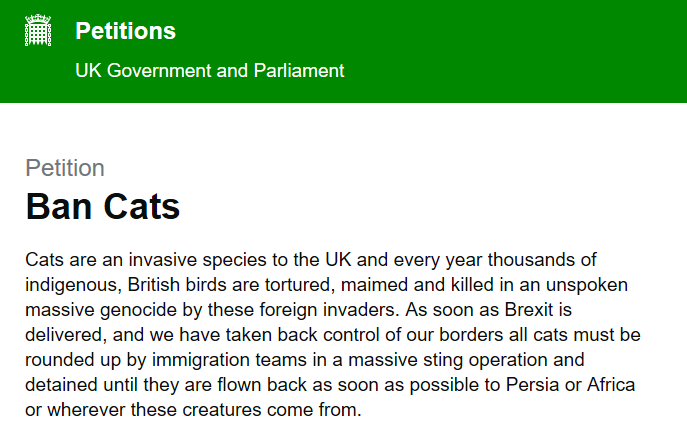
Note: this was clearly spoofed and not designed to be confused with the actual UK government petitions site. If you try anything similar, keep ethics and transparency in mind.
Making the call to action more interesting
On the real e-petitions site you can only support a petition. There is no way to vote it down. That means any visitor who opposes the idea has no interaction other than closing the tab.
I wanted a different dynamic, so on my spoof page I added a “beta feature” that let people vote for or against the notion. This:
- made the page feel more democratic
- increased the number of people who would click something
- gave me another dimension of data to play with
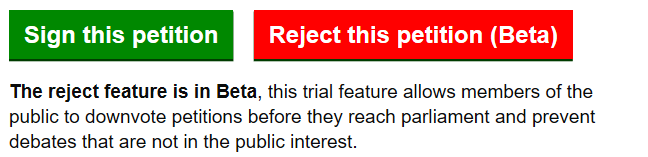
The call to action then linked through to this very blog article using an internal anchor, where I explained the experiment in full and added tracking to see how people behaved.
Distribution: launching the campaign on LinkedIn
Once the landing page and tracking were ready, I shared the link on LinkedIn with a carefully worded post about how outrageous it was that a petition like this could even exist, let alone attract enough signatures to be debated in Parliament.
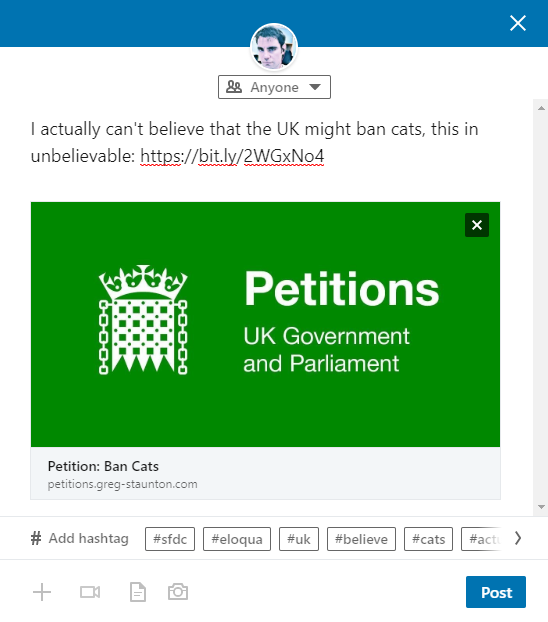
I also sent the link to a few friends who I knew would react and share it in their own circles.
Live results: what actually happened
The reaction was immediate. People either found it hilarious or were furious. It began to surface in forums and private groups and started to behave like a mini viral event.
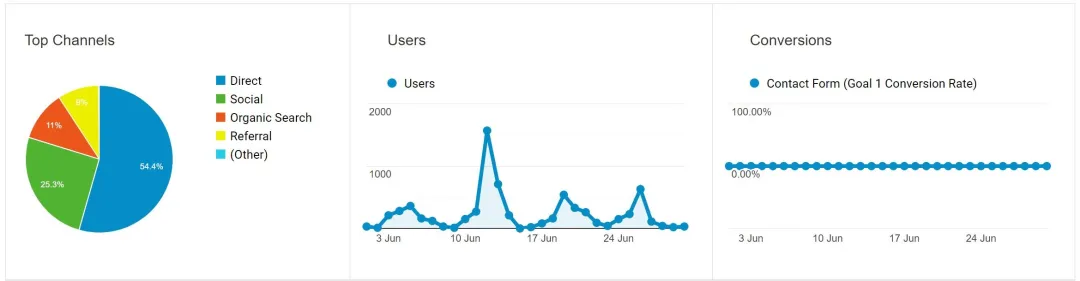
You can see the result in the analytics: one huge spike in website traffic in a single day, purely driven by this experiment. For something I built because I was bored on my commute, that was a solid return.
There was a downside. The spoof page and the campaign were reported and the whole thing was shut down the same day. That was a useful reminder that if you play with strong emotions and political topics, you need to be extremely careful and ready for pushback.
The important part is that the campaign demonstrably worked. It grabbed attention, created a reaction and gave me real data, real learnings and a story that stood out from every standard case study.
And for the record, again:
I do not hate cats.
Key lessons from this disruptive campaign
- Emotion drives action. People reacted because the idea of banning cats hits a nerve. Without that emotional hook, it would have gone nowhere.
- Format and context matter. Spoofing the visual style of a petition site made the idea feel more tangible. Without that familiar frame, it would have just been a joke post.
- Risk is real. You cannot play with political context and outrage without considering complaints, moderation and platform rules.
- Small experiments teach a lot. This campaign required very little spend. The main investment was creativity and a bit of build time.
- Disruption is a tool, not a personality. You do not need to be outrageous all the time. You can use disruptive tactics selectively when the goal justifies the risk.
Conclusion
This campaign started as a reaction to feedback on a job application and turned into a live experiment in disruptive marketing. It hijacked a real world context, used a ridiculous but believable premise and drove a measurable spike in engagement and traffic.
The point is not that every brand should spoof petitions or talk about banning cats. The point is that there is value in thoughtful disruption when you:
- understand your objectives clearly
- design for emotion and shareability
- accept the risk and stay inside ethical boundaries
If you would like to explore disruptive but responsible campaign ideas for your own brand, we can build something that gets talked about for the right reasons.
Want to design a campaign people actually talk about
I help teams move beyond generic campaigns and build ideas that earn attention without burning trust. If you want to discuss disruptive concepts, guardrails and execution, I am happy to share what I have learned.